
Foto: JGU
Ion Milling (PIPS)
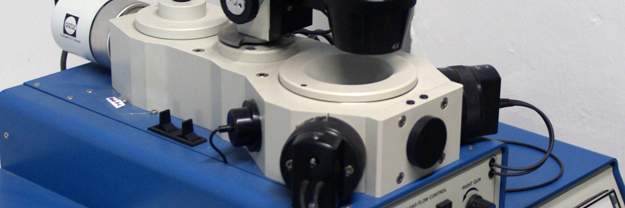
Many bulk materials like metals, ceramics, semiconductors, minerals and multilayer or cross-section samples cannot be made electron-transparent by mechanical sectioning alone. For these specimens the EMC-M operates a Gatan Precision Ion Polishing System (PIPS), which thins samples to the few tens of nanometres required for (scanning) transmission electron microscopy.
Preparation usually begins mechanically: the sample is cut, ground and, where appropriate, dimpled to a central thickness of only a few micrometres, so that the subsequent ion milling has to remove as little material as possible. The pre-thinned disc is then mounted in the PIPS, where two independently controllable argon-ion beams sputter material from the top and bottom faces of the specimen. The sample rotates continuously so that material is removed evenly and a large, uniformly thin area is produced around a central perforation, whose edges are ideal for high-resolution imaging.
The key parameters, ion energy (typically a few keV down to a few hundred eV), beam angle and milling time, are chosen according to the material. Milling starts at a comparatively steep angle for a high removal rate and is finished at very low angles and low energies. This low-energy final polishing step minimises the amorphous damage layer and implantation of argon that ion beams inevitably introduce, and therefore preserves the true structure of the sample for atomic-resolution TEM and analytical work. For beam- or temperature-sensitive materials the specimen stage can be cooled with liquid nitrogen during milling. The result is a clean, artefact-poor, electron-transparent specimen suitable for imaging, diffraction and spectroscopy at the EMC-M.